




AURORA VENTURINI was born in 1921 in La Plata, Buenos Aires, Argentina. She wrote more than forty books. In 2007, she received the Página/12 New Novel Award for Cousins. She died in 2015, in Buenos Aires, at the age of ninety-two.

Books
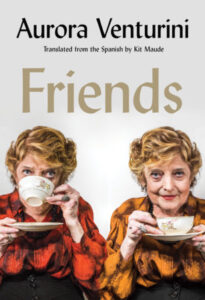
Friends
From prize–winning author Aurora Venturini, a masterful and acerbic novel about a successful artist in her 80s returning to her hometown in Argentina after decades living and working in Europe, reckoning with old and new friends, lovers, and ideasIn a breathless, incantatory voice, Friends tells the story of Yuna Riglos, a celebrated Argentine painter nearing the end of her life. From her apartment in La Plata, Yuna writes as she paints: obsessively, associatively, driven by memory rather than chronology. Fame has not delivered peace. Instead, it has sharpened her awareness of what art cannot redeem.
At the center of the book is Antonella, a teenage girl from the slums who enters Yuna’s life as a housekeeper and becomes something far more unsettling: muse, double, survivor, and moral reckoning. As Yuna shelters Antonella from an unspeakable past of hunger, violence, and incest, the novel probes the uneasy ethics of care, authorship, and representation. What does it mean to protect another person—and what does it mean to turn their suffering into art?
Threaded through the narrative are spectral presences from Argentine and European culture—Pizarnik, Lautréamont, Dante, Goya—figures of genius and despair who haunt Yuna’s imagination as both warning and justification. Friendship, especially between women, emerges as both refuge and trap, most painfully embodied in the fate of Yuna’s fellow artist Matilde du Pin.
By turns savage, tender, comic, and horrifying, this is a novel about beauty and monstrosity, class and cruelty, the body as archive, and the terrible persistence of memory. Friends asks whether art can offer salvation—or whether it merely gives shape to what cannot be forgiven or undone.
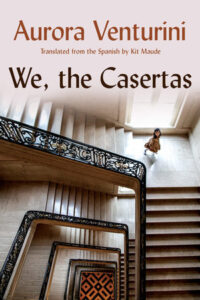
We, the Casertas
From prize–winning author Aurora Venturini, a Gothic masterpiece following a gifted Argentine girl who left for Europe in search of meaning, and the relentless punishments of womanhood in the 1940sIn deliciously ironic, and at times breathtakingly poetic prose, We, the Casertas is the story of Chela, the first-born child to a wealthy family in Buenos Aires. Threatened by her extraordinary intellect, her parents immediately take against her, instead lavishing attention on her beautiful sister. Chela is soon exiled to the attic and allowed to run wild, her only friend a lame owl with whom she explores the countryside.
Chela’s intellectual curiosity grows and she becomes a brilliant student, excelling at subject after subject, and eventually breaking free of the family that has always misunderstood her. But her troubles don’t end there. After falling in love with a married man more than twice her age, she has her heart broken when he refuses to divorce his wife. In her hurt, she flees to Chile where she befriends Pablo Neruda, before heading to Europe where she falls in with a trio of mysterious aristocratic intellectuals dabbling in black magic. After her estate is appropriated by the Peronist government, Chela goes in search of her great aunt in Sicily where she embarks upon a passionate affair, goes treasure hunting with local sailors, and discovers an old family relic.
We, the Casertas is a wild, unpredictable novel about the horrors of family life and the desperate loneliness of womanhood in the mid-century.
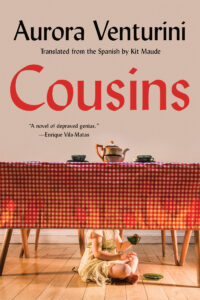
Cousins
Four women from La Plata, Argentina, are forced to suffer through a series of ordeals thanks to their impoverished, dysfunctional family—in this darkly comic literary masterpiece from Aurora Venturini, never before translated into EnglishAt the age of eighty-five, Aurora Venturini stunned Argentine readers when her darkly funny and formally daring novel, Cousins (Las primas), won Página/12’s New Novel Award. She had already written more than forty books, but it was only then, in 2007, that she was widely recognized as a paradigm-shifting voice in Spanish-language literature.
Venturini never stopped writing in her ninety-two years, and produced an oeuvre that is mischievous and stylish, vital and mysterious, and completely original. She lived a life immersed in the literature and culture of the twentieth century: her first award was given to her in person by Jorge Luis Borges; she was friends and colleagues with Eva Perón; and when she lived in exile in Paris, she socialized with a sparkling milieu of writers and philosophers, including Simone de Beauvoir and Jean-Paul Sartre.
Cousins, widely regarded as Venturini’s masterpiece, is the story of four women from an impoverished, dysfunctional family in La Plata, Argentina, who are forced to suffer through a series of ordeals, including illegal abortions, miscarriages, sexual abuse, disfigurement, and murder, narrated by a daughter whose success as a painter offers her a chance to achieve economic independence and help her family as best as she can.
Neighborhood mythologies, family, female sexuality, vengeance, and social mobility through art are explored and scrutinized in the unmistakable voice of Yuna—who stares wildly at the world in which she is compelled to live—a voice unique in contemporary literature whose unconventional style can be candid, brutal, sharp, and utterly breathtaking. With the translation of Cousins into several languages for the first time, Aurora Venturini is now being discovered internationally and championed as a major voice in Latin American literature.